If you’ve lost most or all of the teeth on an upper or lower arch — or you’re facing that — you’ve probably run into the term all on 4 dental implants and wondered what it actually means. It’s one of the most searched full-arch options for a reason: it replaces a whole row of teeth with a single fixed set of teeth anchored on dental implants, rather than a denture that comes in and out. As a family practice that has cared for our neighbors in Manassas and Dumfries for years, we’d rather help you understand your options than have you guess from an ad. So here’s the honest, plain-language guide we’d give a friend — what All-on-4 and full-arch implants are, how they compare to dentures, and how we figure out whether they’re right for you.
What are All-on-4 and full-arch dental implants?
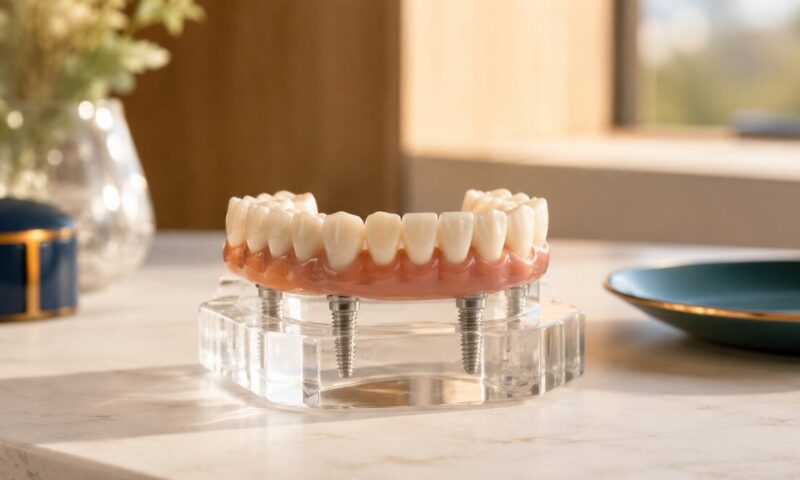
Full-arch dental implants replace an entire arch of missing teeth with a fixed bridge that’s supported by a small number of implant posts placed in the jaw. All-on-4 is one specific, widely known version of that approach: a full arch of teeth supported on as few as four implants. “All-on-4” is a branded technique (originally developed by Nobel Biocare), and today it’s also the phrase most people search for — but it’s one option among several full-arch designs, not a generic category, and choosing it is a clinical decision rather than a brand you ask for by name.
The key idea is simple. Instead of one implant per missing tooth, a full-arch restoration uses a few strategically placed posts to carry a complete set of teeth. That keeps the treatment more efficient and, for many people, more affordable than replacing teeth one at a time. You can read a plain-language overview of how implants work from the ADA’s MouthHealthy patient guide, and we walk through the details together at a consultation.
How full-arch implants work — as few as four implants, one fixed arch
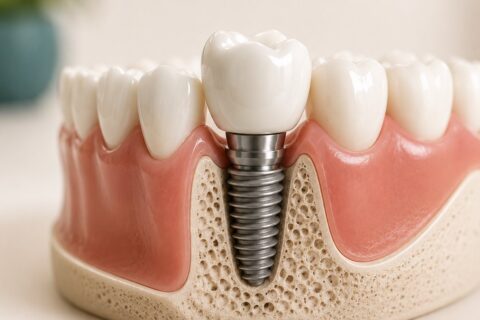
Here’s what’s happening beneath a full-arch restoration. A few implant posts — often four on an arch, sometimes more — are placed into the jawbone, where they gradually fuse with the bone over the following months in a process called osseointegration. Once they’ve integrated, they act as sturdy anchors. A custom arch of teeth is then secured to those posts, so the final result stays put: it doesn’t rock, slip, or need to be taken out at night.
Two teeth toward the back of the arch are often placed at an angle rather than straight up and down. That’s the small engineering trick that lets the design use fewer implants — angling them takes advantage of the denser bone that’s usually available toward the front of the jaw, which is also why some people can avoid a separate bone-grafting step. Whether that applies to you depends on your own bone, and that’s exactly the kind of thing we check before recommending anything. If bone volume is the question for you, our guide to bone grafting for dental implants explains when a graft is and isn’t needed.
You may also see the phrase “teeth in a day.” In many cases a temporary, fixed set of teeth can be attached to the implants shortly after they’re placed, so you leave with a full arch rather than going without. The final, permanent teeth come later, after healing — the same-day set is a provisional, not the finished restoration. We’re careful to set that expectation honestly, because the timeline varies from person to person.
All-on-4 vs All-on-6 and other configurations
All-on-4 is the best-known name, but it isn’t the only design. Some arches are restored on five or six implants (“All-on-6” and similar), and the right number depends on your bone, your bite, and whether it’s an upper or lower arch — the upper jaw is softer and sometimes benefits from more support. More implants isn’t automatically “better”; the goal is the most stable, longest-lasting result for your mouth. This is a decision we make with you at the planning stage, using a 3D scan rather than a rule of thumb.
Full-arch implants vs traditional dentures
If you’ve worn a traditional denture — or watched a parent struggle with one — you already know the frustrations: movement while eating, sore spots, adhesive, and the sense that it never quite feels like your own teeth. This is the comparison most people are really asking about when they search all on 4 vs dentures.
A removable denture rests on the gums and relies on suction or adhesive to stay in place. A full-arch implant restoration is anchored to posts in the jaw, so it behaves much more like natural teeth. That difference shows up in day-to-day life: what you can comfortably eat, how confidently you can speak and smile, and how the restoration feels over time.
Stability, bone preservation, and daily life
There’s also a quieter, longer-term difference. When teeth are missing, the jawbone that used to support them slowly resorbs — which is part of why long-time denture wearers often notice their denture fitting worse and their facial profile changing over the years. Because implants transmit chewing forces into the bone, a full-arch restoration helps preserve the bone around the posts in a way a gum-supported denture doesn’t. It’s one reason many people who are tired of relining and refitting a denture ask us about a fixed option.
None of this means a denture is the wrong choice for everyone — cost, health, and personal preference all matter, and a well-made denture serves many people well. If you’re weighing every route, our overview of implants vs bridges vs dentures lays the options side by side, and you can learn more about conventional dentures too.
| Traditional denture | Full-arch implants (e.g. All-on-4) | |
|---|---|---|
| How it stays in | Rests on the gums; suction or adhesive | Fixed to implant posts in the jaw |
| In your mouth | Removable; taken out to clean | Stays in permanently |
| Feel while eating | Can move; some foods are harder | Behaves much more like natural teeth |
| Effect on bone | Doesn’t stop bone loss underneath | Helps preserve bone around the posts |
| Upkeep | Periodic relines and refits as the jaw changes | Daily cleaning; regular professional checkups |
Are you a candidate? Bone, health, and timing
Most people who are missing a full arch of teeth, or whose remaining teeth on an arch can’t be saved, are candidates for some form of full-arch implant treatment — but all on 4 dental implants candidacy comes down to a few real factors we check in person:
- Bone — there needs to be enough healthy jawbone to hold the implants, though the angled design can often work with less than you’d expect. Where it’s short, grafting may be an option.
- Gum and overall health — healthy gums support healthy implants, and some medical conditions affect healing. We’ll talk through your history openly.
- Habits and timing — smoking and uncontrolled conditions can slow healing, and there’s a planning-and-healing timeline to account for rather than an overnight fix.
“Not a candidate right now” rarely means “never.” Often it means one preparatory step first. The only way to know is an exam and a 3D scan — you can read patient-friendly background from the U.S. National Institute of Dental and Craniofacial Research (NIDCR), then let us look at your specific situation.
What the process looks like at our Manassas and Dumfries offices
Every case is a little different, but the shape of the journey is consistent. It starts with a consultation and a 3D scan, so we can plan around your bone and bite rather than guessing. When the implants are placed, a temporary fixed arch can often go on soon after, so you’re not left without teeth. Over the next few months the implants integrate with the bone, and once they’re solid, your final, custom arch is secured in place. Throughout, we keep you informed about where you are in the timeline — we’d rather over-explain than have you wondering. Our dental implants page covers the treatment in more depth, and families across Manassas and Dumfries are welcome at either office.
Caring for a full-arch restoration
A fixed full arch is easier to live with than a removable denture, but it isn’t maintenance-free — and the maintenance matters more than most people realize. Daily cleaning around and under the arch, plus regular professional checkups, keeps the gums and the bone around your implants healthy. That’s worth doing well: keeping the tissue around your implants free of inflammation supports not just the restoration but your broader health, since gum inflammation is linked in research to overall inflammatory health. Keep those habits up and a full-arch restoration is built to serve you for the long term.
“What patients tell us, again and again, is that the difference isn’t really about the teeth themselves — it’s that they stop thinking about their teeth. They eat what they want, they laugh without checking, and the daily worry that came with a loose denture just goes away. That’s what we’re actually restoring.”
— Dr. Diana Saffarini, Naeem Family Dentistry
Talk to us about full-arch options
If you’re missing a full arch of teeth, or you’re tired of a denture that won’t cooperate, the honest next step is a conversation — not a commitment. We’ll look at your bone and gums, walk you through whether All-on-4 or another full-arch design fits, and give you a clear picture before you decide anything. Request an appointment and we’ll take it from there.
Frequently asked questions
No. A traditional denture is removable and rests on your gums, while an All-on-4 restoration is a fixed arch of teeth anchored to implant posts in the jaw. It stays in permanently and behaves much more like natural teeth — you don't take it out to clean it.
As few as four per arch in the All-on-4 design, though some cases use five or six for extra support. The right number depends on your bone, your bite, and whether it's an upper or lower arch, which we assess with a 3D scan.
Often, yes — a temporary fixed arch can frequently be placed soon after the implants go in, so you're not without teeth. Your final, permanent arch comes later, after the implants have healed and integrated with the bone.
Many people do, because the angled implant design can work with less bone than a straight placement would need. Where bone is short, grafting may be an option. An exam and 3D scan are the only way to know for sure.